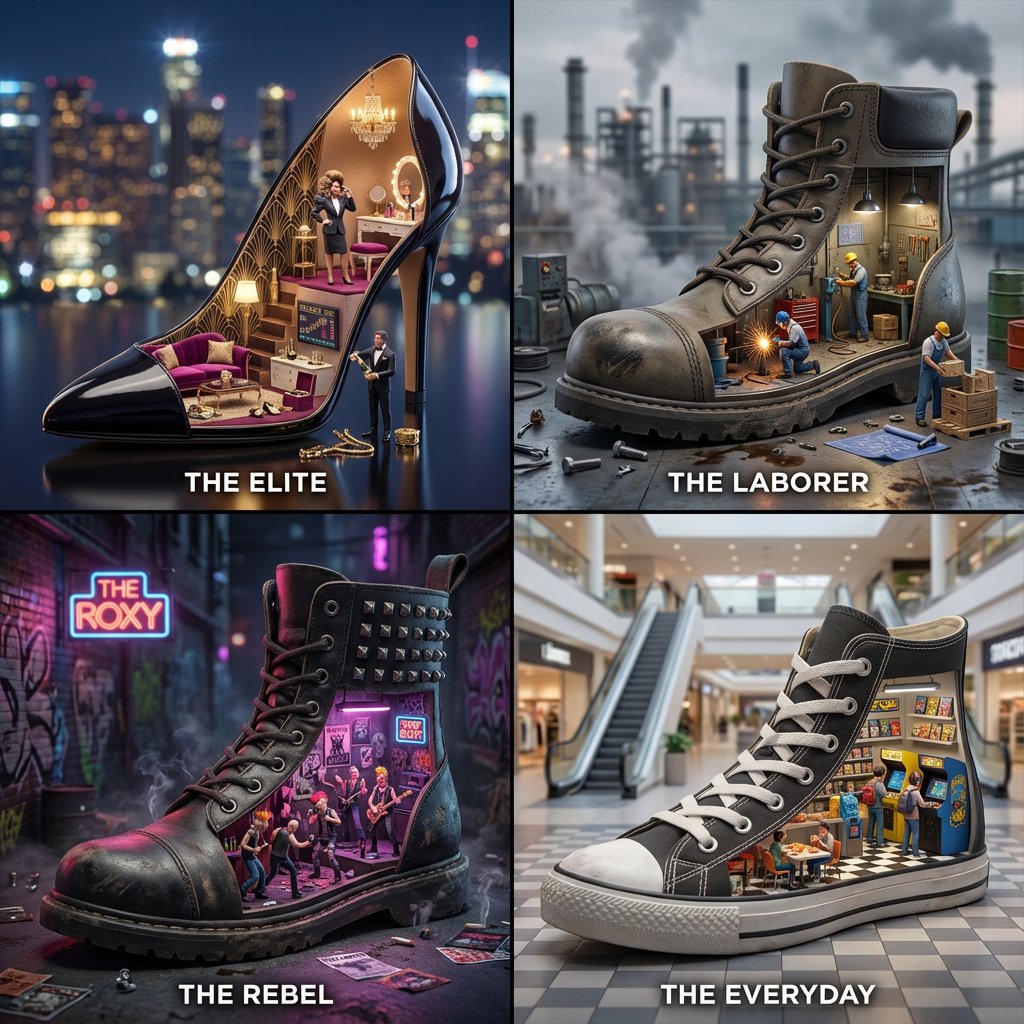

模板案例
鞋中微缩百年社会
提示词
中文提示词
instruction>

Input A 是一个历史时期(例如:1700 年代、1920 年代、1990 年代、赛博朋克)。
将该时期拆分为 4 个社会经济原型,以确保多样性:
     精英(高阶层):财富、奢华、虚荣。
     劳工(工人阶层):工业、坚毅、疲惫。
     叛逆者(反文化):音乐、地下、夜生活。
     日常者(家庭):学校、家庭、杂货。

  2. 容器(鞋履庄园):
     格式:2x2 网格。
     对象:每个原型对应一个独特鞋型轮廓(例如:丝绸高跟鞋、工作靴、厚底松糕鞋、乐福鞋)。
     剖面:鞋的侧面被切掉,露出多层内部空间。

  3. 微种群
  关键:鞋内居住着 1:12 比例人偶。
     居民:确定谁住/在这只鞋里工作。
         (例如:1920 年代高跟鞋 -> 一位正在化妆的弗拉帕女孩。1950 年代靴子 -> 一位擦拭油污的机修工。1700 年代搭扣鞋 -> 一位数硬币的商人)。
     互动:人偶必须处于“活跃”状态,而非静止。他们正在爬梯子、上货、端饮料,或懒洋洋地倚靠家具。

  4. 室内设计
     建筑:定制地板、墙纸与灯具,与鞋款氛围匹配。
     密度:别只把物品放货架上,要“散落”。
         精英:打开的珠宝盒、洒出的粉末、丝绸丝带。
         劳工:油渍、散落的钉子、蓝图、锯末。
         叛逆者:地板上的黑胶唱片、香烟烟雾、海报。
         日常者:杂货、书籍、折好的衣物。

  5. 情境背景
    背景为“虚化(Bokeh)”,但暗示鞋被穿上的地点。
         精英:舞厅吊灯 / 歌剧包厢。
         劳工:工厂蒸汽 / 农田。
         叛逆者:黑暗小巷 / 爵士俱乐部霓虹。
         日常者:郊区街道 / 市场摊位。

  6. 灯光与氛围:
     叙事灯光:光源来自鞋内部微型照明(如微型吊灯、悬挂工作灯泡、霓虹酒吧招牌)。
     尺度:微距摄影景深。人偶必须呈现高品质手绘微缩模型质感。

  输出:一张 2x2 网格图像,1:1 纵横比,3D 立体模型渲染,“微型生活”美学,8K。
</instruction>
英文提示词
instruction>

Input A is a Historical Era (e.g., 1700s, 1920s, 1990s, Cyberpunk).
Break the Era into   4 Socio-Economic Archetypes   to ensure variety:
     The Elite (High Class):  Wealth, luxury, vanity.
     The Laborer (Working Class):  Industry, grit, exhaustion.
     The Rebel (Counter-Culture):  Music, underground, nightlife.
     The Everyday (Domestic):  School, home, groceries.

  2.  Container (The Shoe Estate):
     Format:  2x2 Grid.
     The Object:  A distinct Shoe Silhouette for each Archetype (e.g., Silk Heel, Work Boot, Creeper, Loafer).
     The Cutaway:  The side of the shoe is removed to reveal a   Multi-Level Interior  .

  3.  Micro-Population
  CRITICAL:   The shoe is inhabited by   1:12 Scale Figures  .
     The Resident:  Identify who lives/works in this shoe.
         (e.g., 1920s Heel -> A Flapper applying makeup. 1950s Boot -> A Mechanic wiping grease. 1700s Buckle Shoe -> A Merchant counting coins).
     The Interaction:  The figures are   Active  , not static. They are climbing ladders, stocking shelves, serving drinks, or lounging on the furniture.

  4.  Interior Design
     The Architecture:  Custom flooring, wallpaper, and lighting fixtures match the shoe's vibe.
     The Density:  Do not just place items on shelves.   Scatter them.
         Elite:  Open jewelry boxes, spilled powder, silk ribbons.
         Laborer:  Oil stains, scattered nails, blueprints, sawdust.
         Rebel:  Vinyl records on the floor, cigarette smoke, posters.
         Everyday:  Groceries, books, folded laundry.

  5.  Contextual Background
    The Background is   Blurred (Bokeh)   but implies the location where the shoe is worn.
         Elite:  Ballroom chandeliers / Opera box.
         Laborer:  Factory steam / Farm fields.
         Rebel:  Dark Alley / Jazz Club neon.
         Everyday:  Suburban street / Market stalls.

  6. Lighting & Atmosphere:
     Diegetic Lighting:  The light comes from miniature sources  inside  the shoe (e.g., a tiny chandelier, a hanging shop bulb, a neon bar sign).
     Scale:  Macro photography depth of field. The figures must look like high-quality hand-painted miniatures.

  Output:   ONE image containing a 2x2 Grid, 1:1 Aspect Ratio, 3D Diorama Render, "Miniature Life" aesthetic, 8k.
</instruction>
×
微信扫码分享
打开微信,使用“扫一扫”即可分享